Engineering considerations
- Geotechnical report, groundwater and nearby structures.
- Approved design, access and working-platform requirements.
- Installation records, inspection and specified acceptance tests.

Deep vibratory treatment densifies suitable granular soils on land or offshore.
Discuss your scope ↗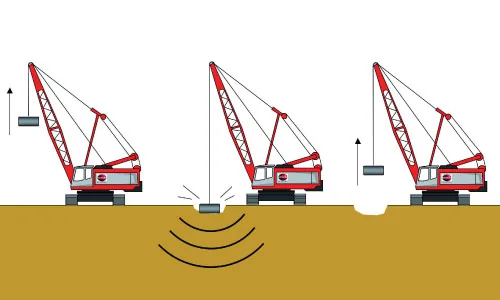
HOW IT WORKS
Confirm soil suitability, treatment depth and verification plan.
Carry out the approved penetration and withdrawal sequence.
Compare pre- and post-treatment field tests against acceptance criteria.
APPLICATION & ENGINEERING
A vibrating probe rearranges granular soil into a denser state. Fines content and groundwater affect suitability; this process differs from installing aggregate stone columns.
TECHNICAL SERVICE GUIDE
Vibrocompaction densifies suitable granular soils by rearranging existing particles. Soil grading and fines content are important selection factors. Unlike vibro replacement, the principal treatment mechanism is densification of the soil itself.
The ground investigation, groundwater conditions and structural requirements inform method selection. Working access, installation sequence and effects on neighbouring structures are reviewed before execution.
Record treatment positions, depth and operating parameters. Compare pre- and post-treatment ground investigation results, such as CPT where specified, with the acceptance criteria.
FROM SITE DATA TO A TECHNICAL PROPOSAL
Share the site location, geotechnical report, structural loads or excavation requirements, drawings and target programme. These inputs allow the engineering team to assess method suitability, equipment access, installation sequence and the required verification plan.
FROM OUR PROJECT REGISTER







AUTHORITIES & FREE ZONES







Discuss your scope, site programme and mobilisation requirements directly with our team.
Request a quote →