Engineering considerations
- Geotechnical report, groundwater and nearby structures.
- Approved design, access and working-platform requirements.
- Installation records, inspection and specified acceptance tests.

Reinforced ground elements support retention or soil stabilization; anchors and passive nails have distinct designs.
Discuss your scope ↗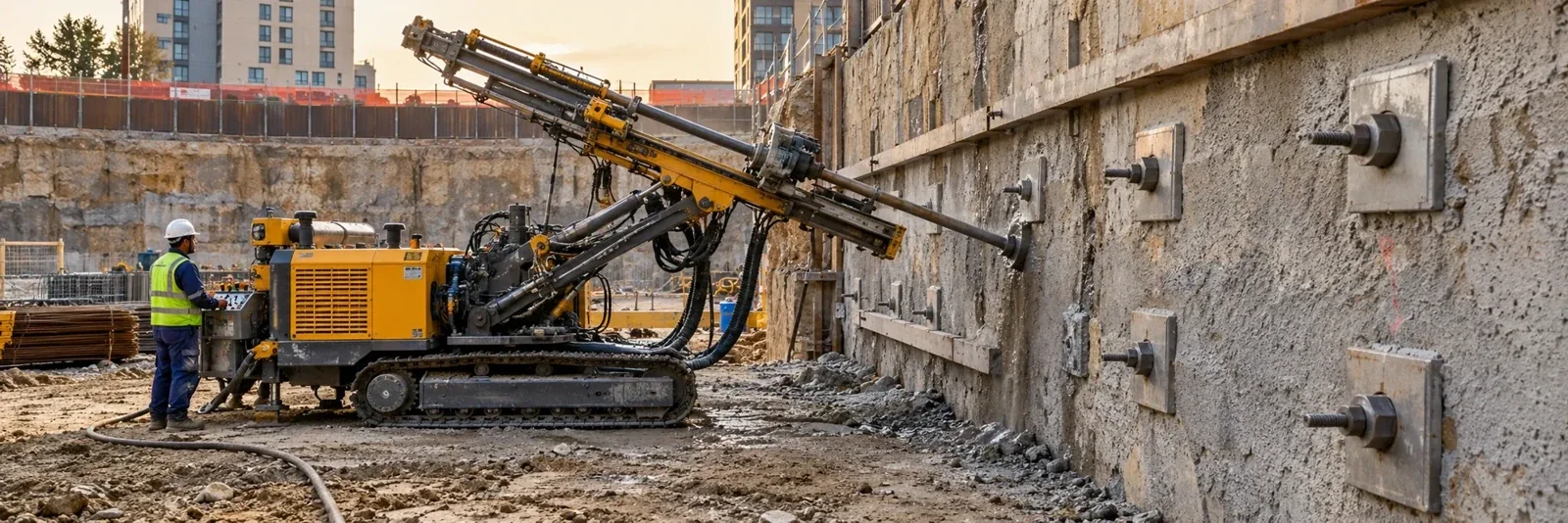
HOW IT WORKS
Drill to the approved inclination and geometry with clearances.
Install reinforcement, grout and connect to the specified facing or retention system.
Perform specified proof tests; stress anchors where applicable and monitor.
APPLICATION & ENGINEERING
Anchors transfer tensile forces beyond the potential failure zone. Free length, bond length, corrosion protection and acceptance testing are coordinated in the design.
TECHNICAL SERVICE GUIDE
Ground anchors provide tensile restraint to retaining systems by transferring force into stable ground. Free and bond lengths, corrosion protection and access outside the site boundary must be resolved during design and permitting. Prestressed ground anchors and passive soil nails are different systems: soil nails develop resistance through ground movement and must not be described as prestressed anchors.
The ground investigation, groundwater conditions and structural requirements inform method selection. Working access, installation sequence and effects on neighbouring structures are reviewed before execution.
For anchors, document drilling, grouting, stressing, acceptance tests and lock-off loads. For soil nails, check reinforcement, grout, facing connections and the specified proof tests; apply the correct acceptance procedure to each system.
FROM SITE DATA TO A TECHNICAL PROPOSAL
Share the site location, geotechnical report, structural loads or excavation requirements, drawings and target programme. These inputs allow the engineering team to assess method suitability, equipment access, installation sequence and the required verification plan.
FROM OUR PROJECT REGISTER







AUTHORITIES & FREE ZONES







Discuss your scope, site programme and mobilisation requirements directly with our team.
Request a quote →